
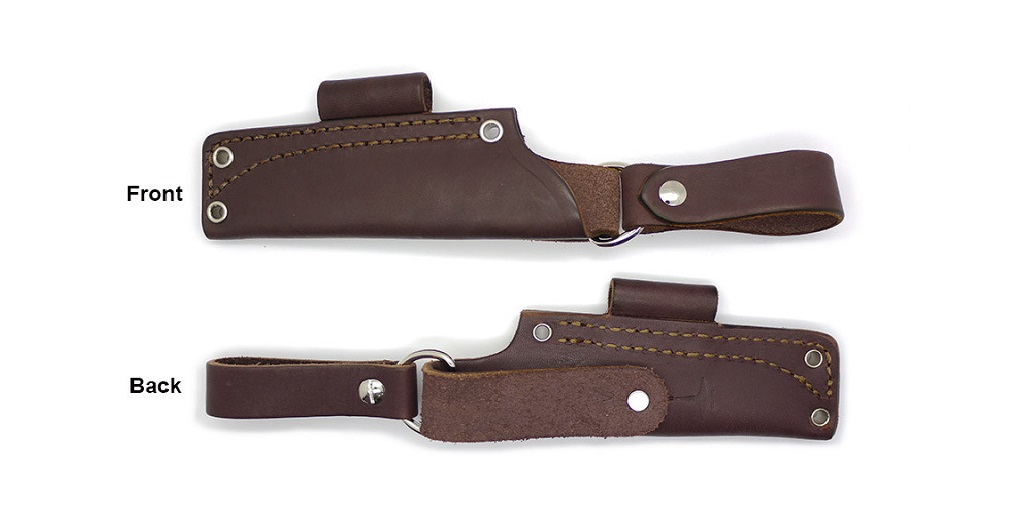
In the market for a new knife sheath? If so, you might be wondering if a leather knife sheath, or a thermoplastic sheath, something like a nylon or Kydex sheath, is better.
Here’s what you need to know.
The Draw of a Leather Knife Sheath
There are numerous advantages of a leather knife sheath compared to synthetic alternatives
- Leather is more comfortable (and gentler). Leather is softer, so if you wear it on your belt, it’s going to be more comfortable than a synthetic sheath, especially with a longer blade. Also, leather will not scratch or otherwise mar the finish of your knife’s blade or scales.
- It will conform to both you (and the knife) over time. Leather breaks in over time and develops a patina. The former aspect means that leather will afford a custom-like fit as the sheath breaks in and wears.
- Leather is a good option if you need a replacement sheath. If you currently have a knife and need a new sheath, leather is the best option because as long as the sheath is roughly the right size and shape, it will accommodate the blade.
- Leather is classy. Lastly, for what it’s worth, leather has a lot of cool factor and classic appeal that thermoplastic alternatives just can’t rival.
Shortcomings
With all of this said, there are some disadvantages to leather sheaths.
- Leather encourages rust. Leather can trap moisture near the blade, which for non-stainless alloys can result in rust, corrosion and pitting. For this reason if you do use a leather sheath, you should not store your knife in it for prolonged periods of time.
- Leather will break down if not properly cared for. Leather is a natural material that will need to be conditioned periodically. Otherwise it will become dry, brittle, and crack.
Thermoplastic Knife Sheaths
Thermoplastic knife sheaths and synthetics such as nylon and Kydex represent a viable alternative to leather for some of the following reasons.
- They offer unparalleled friction fit. A good thermoplastic knife sheath will fit a blade like a glove, affording a far superior friction fit when compared to leather, especially if the blade is inverted and carried tip-up.
- They are generally far more versatile with respect to mounting and draw options. Most thermoplastic knife sheaths enable a variety of different mounting options for tip-up and down carry as well as for cross-draw and scout carry.
- They require no maintenance. Leather needs to be conditioned; synthetic sheaths do not.
- There’s no break-in period. Leather needs to be used and broken in before it will offer up its full potential. The same is not true of synthetic sheaths.
With That Said…
At the same time, there are some shortcomings associated with synthetic sheaths.
- You must get a model specifically compatible with your The majority of synthetic and thermoplastic sheaths are manufactured to fit the specific dimensions of a single model of knife. You can’t just get any plastic sheath for your knife, so you need to be careful before buying.
- It’s not going to be as comfortable. While there are some very comfortable and unobtrusive thermoplastic sheaths, many find the sharp corners and angles to be somewhat less than comfortable, especially when compared to leather.
Where to Explore Your Options
Interested in a new sheath for your favorite knife, or just want to see what some of your options are? Check out The Knife Connection. They carry a wide range of sheaths and other knife accessories. Start your search there and if you have any questions about compatibility (or anything else mentioned in this article) get in touch with their customer service directly.