
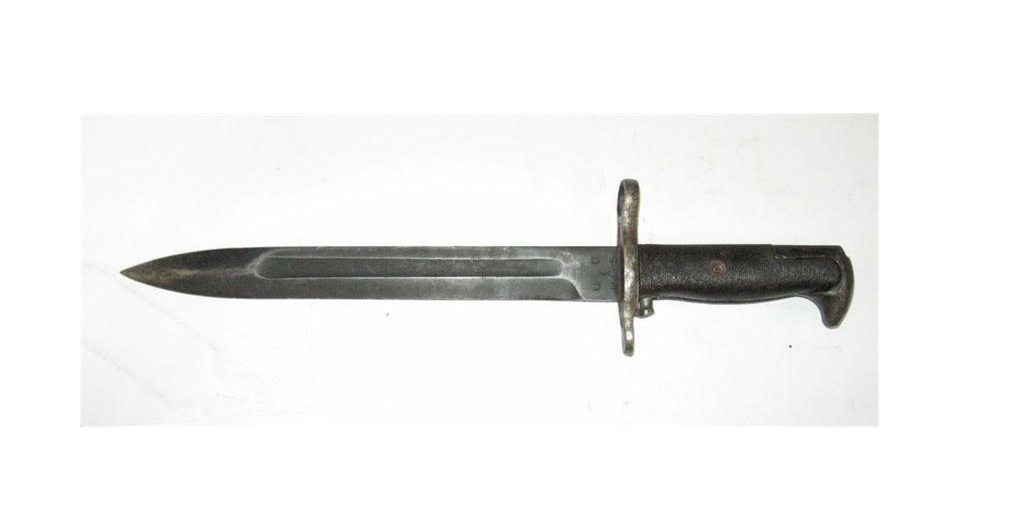
Like the classic “ping” of the spent clip and the timeless appeal of the M1907 sling (which still bears practical value to this day, nearly 120 years after it was developed) the M1 bayonet is a staple of the undying image of the M1 Garand.
So here’s just about everything you need to know about the M1 bayonet which, like the M1 Garand rifle, is an icon in its class.
It Wasn’t the First Bayonet Paired with the M1 Garand
First off, the M1 bayonet was not the first bayonet that was developed for the M1 Garand. Well, actually, let’s rephrase that.
It’s not the first bayonet with which the M1 Garand was paired. That honor belongs to the M1905 bayonet.
But the M1905 was not developed for the Garand. It was developed long before the Army thought it needed a large semi-automatic platform.
It was actually developed for the M1903 Springfield rifle, another icon. An interesting fact for you is that though the two rifles have very different actions (bolt-action repeater vs. gas-operated semi-automatic) they fired the same cartridge (.30-06 Springfield).
Also, for a time, they used the same bayonets, too – the M1905.
The M1 Bayonet Evolved from a Cut-down Version of the M1905 Bayonet
The M1905 which we have already introduced was a large, somewhat unwieldy implement. It gave the bearer a lot of extra reach – this thing was practically a sword bayonet, at 20 inches overall, with 16 inches of blade length.
However, while it featured an ergonomic handle with nice wood grips and could be detached easily from the rifle, this thing was neither practical nor good for general utility or for hand-to-hand combat. On the end of the rifle, sure – but in the hand, not so much.
So the Army decided it was time for a change, and they cut down the M1905 substantially.
Enter the M1 bayonet, which is literally just a cut-down version of the M1905, and the first bayonet officially designed as an M1 Garand bayonet.
By 1943, the Army had made the not-so-difficult decision to lop 6 inches off of the end of the M1905. Thus, the M1 bayonet was born.
The first M1 bayonets were otherwise very like the M1905 in basically every way. Like the M1905, the M1 had a square fuller and a crossguard. Also, like the M1905 (later models, at least), the M1 had phenolic handle scales. Basically, the M1 was the M1905 with a 10-inch blade and a spear point.
Well over 2 million of these were produced, with the majority coming from Union Fork and Hoe Company. A respectable number were also produced by Utica Cutlery Company, American Fork and Hoe, and Oneida.
The M1 Bayonet is not Compatible with the M1 Carbine
Don’t make the common mistake of believing that the M1 bayonet, since it is compatible with the Garand, is also compatible with the M1 carbine. It is not.
In fact, the M1 carbine, in its earlier iterations, was produced entirely without bayonet lugs. Models with lugs weren’t widely issued until World War II had ended.
Due to the lack of bayonet lugs in the earlier models, troops that were issued M1 carbines were also issued the M3 fighting knife.
Later on, when it was determined that the M1 carbine would be a more competent implement of war if it were given bayonet lugs, it was equipped with them. Then, it could be equipped with the M4 bayonet, which was basically the M3 fighting knife adapted to mounting to a bayonet lug.
Where Can You Get an M1 Bayonet?
Interested in getting an M1 bayonet for your Garand or for your historical collection? Visit SARCO, Inc., online at SarcoInc.com. They carry one of the world’s largest collections of firearms, parts, and military collectibles, including bayonets and scabbards, such as the M3 scabbard.
Check out their website to learn more or get in touch with them at 610-250-3960.