
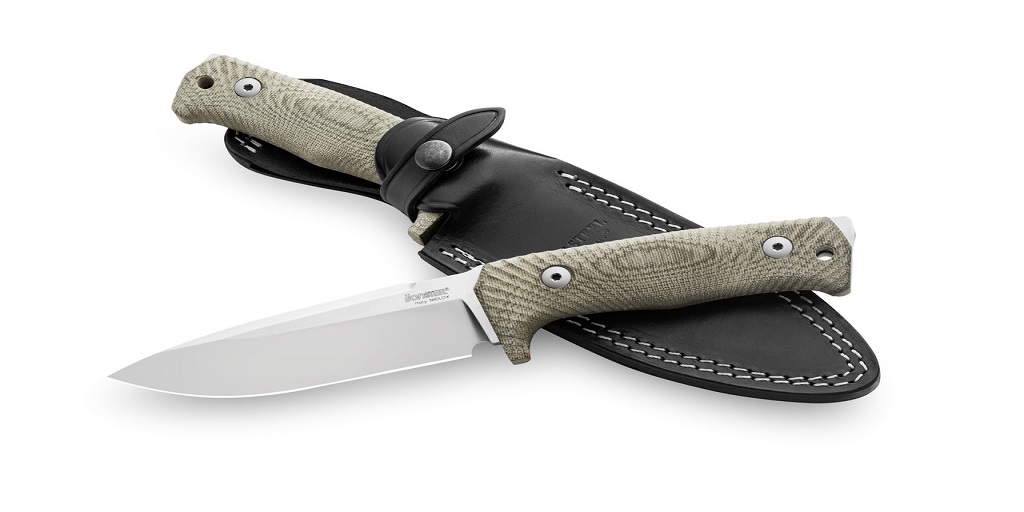
There’s no shortage of great knife brands and knives in the modern market, whether you’re a collector, a sportsman, you carry daily, or whether you prefer fixed blades or folders.
The variety makes it increasingly hard to differentiate the number of brands and makers out there, but some, like LionSteel, rise to the top of nearly every list that names them.
While there are far more than two redeeming qualities to the knives made by this company, here are two of the best.
The Steels They Use
There are so many knifemakers out there that are content to use basic tool steels in their creation. You could rattle off 10 of them in as many seconds: 1095, D2, 8Cr13MoV, and 12C28N are just a few of these.
Admittedly, these are not “bad” steels by any stretch of the imagination, and the truth is that, with a good heat treatment, some of them can be quite good if not excellent.
But they are not super steels. You know, alloys that offer a perfect balance of those fabled three attributes of knife steel: hardness for edge retention, toughness for wear and shock resistance, and of course, corrosion resistance to resist staining and rust.
For the longest time, industry insiders would tell you that you can have two of the three in any given alloy, but that no steel was truly well balanced across the three. That is no longer the case, and there are super steels that really offer it all.
LionSteel uses many of these. For instance, some of its knives are made with M390, a very carbon, chromium, and molybdenum-rich alloy that not only can take an impressive heat treatment, it bucks rust and wear admirably as a result of its joint moly and chrome content.
That’s just one of them; another steel that LionSteel uses in several of its models is Niolox, which is another high-end tool steel that, along with healthy helpings of molybdenum, carbon, and chromium, has some niobium in the matrix.
Niobium is only rarely added to knife steels, but where present, it improves grain structure and carbide consistency and distribution, enabling a more consistent heat treatment and edge-retention, and on top of that, it has a pointed ability to resist staining, corrosion, and rust.
These are just a few of the top-tier steels that LionSteel uses in its knives, but rest assured, they use some of the best alloys in the knife and tool industry.
Their Designs
The other big thing you will love about LionSteel knives, provided you appreciate a hardworking tool, is that their designs are simple.
Some knifemakers generate buzz by jumping on the karambit and sheepsfoot bandwagon, or by adopting new locks like button and bar locks. Not that there’s anything wrong with that, but LionSteel knives are refreshingly understated, with an emphasis on simple performance.
Look at any collection of their knives and you will be greeted, by and large, by a variety of drop point fixed blades that are in the middle of the road in terms of size, and which offer comfortable, simple ergonomics.
Their knives are not intended to win pageants; they are intended to perform. If you’re looking for a new tool that will do what it’s supposed to do, even if it doesn’t offer the most captivating aesthetics, you could do a lot worse than a LionSteel.
Where to Get More Familiar with LionSteel Knives
Looking for a new knife? Whether you’re a hunter, camper, hiker, or bushcrafter, LionSteel is a solid choice. You can check out a catalog of their models online at The Knife Connection, which also carries a wide range of inventory from many of the knife industry’s other top manufacturers.